Psychological Horror vs Jump Scares: What Actually Frightens Players
One makes you flinch for a second. The other follows you to bed. Here is how dread and shock really differ, and why a game needs both.
Ask ten players what scared them in a game and you will get two very different kinds of answer. Some will describe a moment, a face at a window, a sudden grab in the dark. Others will struggle to name a single event and instead describe a feeling, the sense that something was wrong for an hour before anything happened. Those two answers map almost exactly onto the two tools every horror game has: the jump scare and psychological dread. They are not the same machine, and treating them as interchangeable is the most common mistake in the genre.
Two different machines
A jump scare is a startle reflex. It is a sudden, loud, or fast event placed against a quiet background. It works on the body before the mind has any say. The heart rate spikes, the player flinches, and a second later it is over. It is honest, effective, and shallow by design. There is nothing wrong with that. A flinch is a real reaction.
Psychological horror works on a slower circuit. It builds an expectation of threat and then refuses to resolve it. It is the unlit doorway you have to walk through, the sound you cannot identify, the growing certainty that the rules of the place are not in your favour. It does not spike the pulse so much as raise the floor under it, so that you spend a long time slightly too alert. That is the feeling players carry out of the room and into the night.
Why jump scares wear out
The trouble with the jump scare is that it is predictable in aggregate. A player cannot consciously anticipate a single scare, but they can absolutely learn the rhythm of a game that uses them constantly. After the third or fourth, the body starts bracing. Once a player is braced, the startle has nothing to work with, because surprise is the entire mechanism.
This is why games that spawn scares randomly tend to feel cheap. The scare fires when no one is looking, or three times in a corridor, or right after the last one, and the quiet stretches that a startle depends on never get a chance to form. A jump scare is only as strong as the silence you spend building before it. Spend that silence carelessly and every scare is a little weaker than the last.
A jump scare is not the loud moment. It is the long quiet that the loud moment interrupts.
The anatomy of dread
Dread is harder to build and far more durable. It comes from a few ingredients working together. Incomplete information, so the player always feels they are missing something. Consistent threat logic, so the danger seems to follow rules the player has not fully learned yet. And vulnerability, so the player believes a bad outcome is genuinely possible.
Crucially, dread does not require anything to happen. An empty room can be terrifying if the game has taught you that emptiness is when things go wrong. This is why atmosphere, sound, and the setting itself matter so much more than the monster. The monster is a punctuation mark. Dread is the sentence.
Using both on purpose
The mature approach is not to choose one. It is to let dread do the heavy lifting and use jump scares as rare, deliberate punctuation. The model looks like this. Spend a long time building unease through space, sound, and uncertainty. Let the player's own imagination supply the threat. Then, at a specific, hand-placed moment that you control completely, pay it off with a real shock.
Build two or three of those payoffs across a whole game, not twenty. Each one lands because the climb before it was real and the quiet around it was protected. This is really a question of pacing, which deserves its own discussion, but the principle is simple. Earn the scare, then place it by hand.
The approach in Cape Mourn
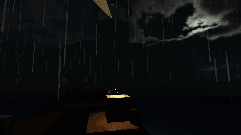
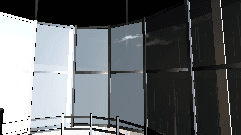
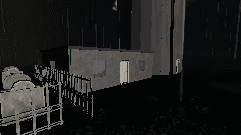
The Lighthouse Keeper is built on that ratio. The night is mostly dread. You manage a failing light, you cross dark ground, and you spend long stretches certain that something is keeping pace with you just outside the beam. The shocks are deliberate and they are rare, because each one is meant to discharge an hour of tension rather than provide a steady drip of noise.
The goal is the second kind of answer, the one where a player cannot quite name what scared them but does not want to turn the lights off. If you are designing toward that yourself and want to compare notes, you can get in touch, or see how the dread reads in the screenshots.