Setting as Character: Why the Place Makes the Horror
The monster gets the poster, but the place does the work. A great horror setting is an antagonist that never has to move.
Name a horror classic and you will probably name its location before its monster. The hotel. The mansion. The derelict ship. The rural town that is too quiet. The creature is often the thing you remember least, because the real work of the fear was done by the place it happened in. The best horror settings are not stages on which scary things occur. They are characters in their own right, antagonists that apply pressure every second the player is inside them.
The place as antagonist
A setting becomes a character when it has intent, or at least seems to. It funnels you where it wants you. It withholds what you need and dangles it somewhere dangerous. It feels aware of you. None of this requires the building to literally move. It requires the designer to treat space the way a writer treats a villain, as something with motives that oppose the protagonist.
When a place is built this way, the player never fully relaxes, because the antagonist is always present. They are standing inside it. There is no scene the location is absent from, which makes it the most persistent source of dread available, far more constant than any monster that has to appear and then leave.
Familiar, then wrong
The strongest horror settings are not alien. They are familiar places that have been turned subtly wrong. A house, a school, a hospital, a chapel. Somewhere the player has an instinctive map of how things should be. The fear comes from violating that map by small degrees. A corridor slightly too long. A room a little too large for its purpose. Furniture overturned, a stain where no stain should be, a door that should be locked standing open.
This is the uncanny, the almost-normal-but-not-quite, and it is more disturbing than pure spectacle because the player's own expectations do the frightening. They brought the sense of how it should be, and the game only had to break it. An entirely invented place cannot be uncanny, because the player has no baseline to violate.
You do not fear the room that was always strange. You fear the room you knew, which has quietly become strange while you were not looking.
Geometry as fear delivery
The raw shape of a level is a fear-delivery system, and most of its language is spatial. A space slightly too large makes the player feel small, exposed, and watched. A space slightly too small makes them feel trapped. Corridors that bend or branch hide what is ahead and create dread of the turn. Dark at the edges of a room implies space you cannot account for.
Sightlines are the key variable. Control what the player can and cannot see and you control their anxiety directly. A long sightline into darkness invites the imagination to populate it. A blind corner promises something behind it. This pairs tightly with audio design, because a sound from a space you cannot see is the geometry and the soundscape working as one.
Telling the story in the walls
A character-setting also carries the narrative without exposition. Every room should imply what happened here before the player arrived. A toppled chair, a meal left uneaten, a child's drawing, a barricade built from the wrong side. These details let the player assemble the story themselves, and a story you deduce is far more affecting than one you are told. It also keeps the place feeling lived in and therefore real, which makes its wrongness land harder.
The island as a character
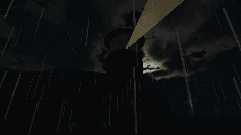
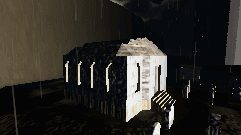
In The Lighthouse Keeper, the island is the antagonist you spend the most time with. The cottage, the tower, the ruined chapel, and the crypt beneath it are all familiar shapes turned wrong by the night and the storm. The geometry funnels you across exposed ground and into tight, blind interiors, and the environment is dense with traces of the keeper who was here before you. You can read the place yourself in the screenshots, which is partly why I find lighthouses such fertile ground, a theme I expand on in why lighthouses are so unsettling. If setting design is your obsession too, do reach out.