Designing a Monster You Rarely See
Show the monster too early and the fear has a ceiling. Keep it just out of sight and the player will build something far worse than you could.
There is a reason the shark is barely in the most famous shark film, and it is not only that the mechanical one kept breaking. A threat you cannot see clearly is a threat your mind is free to perfect. The moment you show a monster in full, you replace an infinite, personal nightmare with a finite object, and an object can be measured, understood, and eventually dismissed. The hardest discipline in creature design is also the most powerful. Show less, imply more, and let the player do the work you never could.
The imagination builds it better
No artist can out-design a frightened imagination, because the imagination is custom-built for the person experiencing it. It assembles a creature from that individual's specific fears, fills in exactly the details that unsettle them most, and never holds still long enough to be examined. Your model, however good, is one fixed thing. Their imagined version is a different, worse thing for every single player.
Give the imagination raw material and room to work, and it will construct something more terrifying than your budget or your concept art ever could. The designer's job shifts from depicting the monster to feeding the process that builds it.
The reveal problem
Every monster has a scare ceiling, and the reveal sets it. Before the player sees the thing, the ceiling is effectively infinite, because the threat is whatever they fear most. After the reveal, the ceiling is fixed at exactly how scary your design happens to be. From that point on, familiarity only erodes it. The tenth sighting is never as frightening as the first, and the first is never as frightening as the dread before it.
This is why pacing the reveal matters so much. A monster shown in the first five minutes has spent its entire budget of mystery up front and has the whole rest of the game to become mundane. The same logic governs jump scares. The unknown is the resource, and revelation spends it.
Before you show the monster, it can be anything. After you show it, it can only ever be less.
The tools of suggestion
Suggestion has a toolkit, and most of it is not visual. Sound is the first and best instrument, a breath, a drag, a call from a direction you cannot see, which is why audio design and monster design are inseparable. Then there are partial glimpses, a shape crossing a doorway, a silhouette at the edge of the light, something that submerges before your eyes resolve it. And there is aftermath, the evidence the creature leaves behind, damage, traces, the bodies of things it reached before you did.
Aftermath is especially potent because it proves the threat is real and capable without ever putting it on screen. The player reads the result and imagines the cause, and the cause they imagine is tailored to frighten them specifically. Folklore has always understood this, telling us what the sea monster did far more often than what it looked like, a point I make in the folklore behind maritime horror.
When to finally show it
Restraint does not mean the monster is never seen. A threat that never materialises at all can start to feel toothless, and the player may quietly conclude they were never truly in danger. The answer is a reveal that is rare, brief, and earned. Build the dread for a long time, then grant one clear, short look at the worst possible moment, and take it away again before the player can study it. One real glimpse, well placed, confirms that everything they imagined was justified, and sends them straight back into not-quite-seeing with the stakes now proven.
Restraint at Cape Mourn
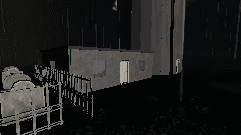
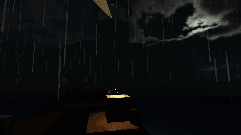
The Lighthouse Keeper is built on this restraint. The drowned and the thing beneath the island are felt far more than they are seen, delivered through sound, through shapes at the limit of the beam, and through what they leave in their wake. The light reaches only so far on purpose, because the dark past its edge is where the player's own imagination does the design work. The rare, deliberate reveal is saved for when it will land hardest. You can glimpse the kind of framing this produces in the screenshots, and if creature restraint is your interest, I would happily talk it over.