Why Scarcity Is Scary: Resource Management in Survival Horror
Give a player plenty and the horror evaporates. Take it away one unit at a time and every small choice becomes a source of fear.
Hand a player a full inventory and infinite ammunition and you have made an action game with a dark colour palette. The monsters can be hideous and the lighting perfect, but the fear will not hold, because fear requires the genuine possibility of failure. Survival horror understood this from the beginning. Its great insight was that the most reliable way to make a player feel vulnerable is not to make the monster stronger. It is to make the player poorer.
Scarcity equals vulnerability
Vulnerability is the emotional core of horror. A powerful character is not frightened, they are inconvenienced. To frighten a player you must strip away their sense of sufficiency, and resources are the cleanest lever for that. When ammunition, health, and light are all in short supply, the player stops feeling like a hero passing through a dangerous place and starts feeling like prey trying to survive it.
Scarcity also forces difficult choices, and difficult choices generate stress on their own, before any threat appears. Do I spend the bullet or run. Do I heal now or save the kit. Every one of those questions is a small dread, and a game full of them keeps the player tense even in empty rooms.
What to make scarce
The classic resources are ammunition, healing, and light, and each does a slightly different job. Limited ammunition makes every encounter a negotiation rather than a fight. Limited healing makes damage matter long after it is taken, so a single bad moment echoes for the next ten minutes. Limited light, which I explored fully in light and darkness as a mechanic, makes the player ration their own ability to see.
Saving can be a resource too. When saves are finite or tied to specific places, the act of saving becomes a relief charged with anxiety, and the stretch between saves becomes genuinely tense, because losing it costs real progress. Scarcity does not have to mean items in a bag. It can mean any limited permission the game grants.
You are not really frightened of running out. You are frightened of the moment you realise you are about to.
The math of dread
The crucial point is that the dread lives in anticipation, not in the shortage itself. A player who has six bullets is not scared of having six bullets. They are scared of the trajectory, the quiet arithmetic that says at this rate I will have none when I most need them. The designer's job is to keep that trajectory visible and uncomfortable.
This means refills should be just frequent enough to keep hope alive and just rare enough to keep the math frightening. Drop too many and the trajectory flattens and the fear dies. Drop too few and the player concludes the situation is hopeless, at which point they stop caring, which is its own kind of failure. You are tuning a slope, and the slope should always feel like it is tilting gently against the player.
Avoiding the tedium trap
Scarcity has a failure mode, and it is boredom. Backtracking through cleared rooms to scrape up three units of something is not tension, it is chores. The trick is to make gathering itself dangerous rather than merely slow. Refills should sit in places the player does not want to go, out in the dark, deep in the level, near where the threat is strongest. Then the act of restocking safety requires spending safety, which keeps the loop charged instead of tedious.
This is the same self-tightening squeeze that good light design produces, and it pairs naturally with deliberate pacing, since a supply run is a perfect way to send a player from a safe valley back up into danger.
Fuel and light at Cape Mourn
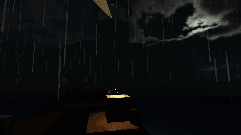
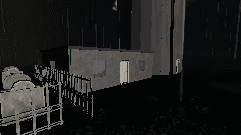
The Lighthouse Keeper builds its scarcity around the lamp. The light must be kept burning, the fuel to keep it burning is finite, and the only way to gather more is to leave the relative safety of the tower and go out into the storm where the danger lives. The resource and the threat are wired together, so every decision to top up the light is also a decision to expose yourself to the dark.
That is scarcity working as intended. The thing you need most is kept exactly where you least want to be. If you are designing economies of fear in your own project, I am always glad to talk it through, and you can see the spaces these runs take place in over on the screenshots page.